If you are seeking hair transplant surgery and are in confusion regarding the number of grafts needed, which is the critical part required to attain a natural, seamless outcome. At Haircosmos, the experts specialize in diagnosing and treating many types of hair loss. The team offers precision, experience, as well as skills to every patient to ensure that people get what they expect with ideal grafts for their unique hairline and scalp.
What is a hair graft?
A hair graft is a scalp tissue piece with one or more hair follicles; generally having one graft has one to four hairs. During a hair transplant procedure, these grafts are extracted from the donor area and are then implanted into the bald areas of the scalp that need treatment. The procedure will be done by the advanced technique by the experienced surgeon. However, the number of grafts determines the coverage and hair transplant density you will achieve. The expert surgeon plans a proper strategic placement plan for each graft that will finally offer a natural hairline look and will transform the overall appearance.
What factors are taken into account to determine the graft numbers?
There is no single figure to know the exact number of grafts needed to get the full coverage head after a hair transplant. The graft requirements vary from person to person, and the needs of the grafts will be determined by the surgeon after taking into consideration many factors listed below:
- Desired hair density
The number of grafts that are needed for the hair transplant depends on an individual’s aim, as they want full dense coverage or moderate density. The hair transplant density expected by the patient will help the surgeon determine the number of grafts required, as the desired aesthetics will influence the graft number.
- Characteristics of the hair
The number of grafts that are finally required depends upon the hair characteristics of the patient, like if they have straight hair, fine hair, darker hair, or curlier hair. These natural hair characteristics help the surgeon to know the number of grafts required to attain the expected head look.
- Quality of the Donor area
The hair transplant surgeon will check the quality of the donor area, as it must have sufficient density and strength to support the grafts. If the donor area of the patient is limited, then the surgeon will also combine the surgical procedure with the growth factor treatment or other hair restoration methods like PRP or GFC that will assist in improving the outcomes at the end.
- Hairline design
It is also the crucial factor that gives a full head of hair coverage. The surgeon offers a well-designed hairline as per the face frame, which matches the natural growth pattern of the patient, and this hairline design will help determine the number of grafts required. The expert doctor at Haircosomos focuses mainly on hairline artistry that goes well with facial features as well, and accordingly, the grafts are determined.
- Scalp laxity
It is the factor that is considered to know the graft number because the more flexible the scalp is, the easier it will be to take and implant the grafts, which ultimately improves the results.
- Blood supply of the bald area
The blood supply of the area that needs treatment plays a vital role in graft survival and in achieving full density. The circulation of the area may sometimes lack the nourishment that is required, which can lead to weak growth or graft failure.
Graft estimations by the area
As per the expert hair transplant surgeon at Haircosmos, the number of grafts required for each specific zone is listed below to get an idea:
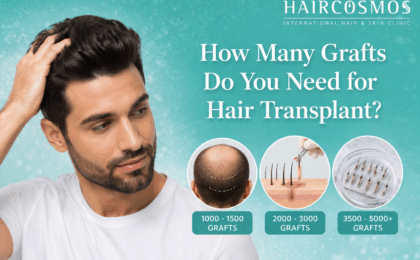
- For the frontal zone and temples, there may be a need for about 1500 to 2500 grafts.
- For a receding hairline, there may be a need for about 900 to 1500 grafts
- For the crown area, there may be a need for about 1500 to 2500 grafts
- For the mid scalp region, there may be a need for about 2000 to 3000 grafts
- For complete coverage of the hair head, there may be a need for about 3500 to 6000 or above grafts
Do personalised assessment matters for hair transplant?
Yes, of course, the personalized assessment matters a lot because a hair transplant involves both science and artistry skills. An experienced hair transplant surgeon will evaluate the scalp and hair loss pattern, but also determine the design with a proper long-term plan that will show excellence in about ten to 20 years. That is the reason why expert doctors at Hiircosmos offer personalized consultations to patients at the clinic. This consultation will help them understand all about the hair loss journey and the causes behind it. Also, they will assess and evaluate the donor areas from which the grafts can be taken. However, the donor may need single or multiple sessions, as discussed during this consultation. A single larger session will be recommended for people who have moderate hair loss with plentiful donor supply, and various sessions are recommended for people with severe hair loss or balding.
How to get the appropriate graft count for long-term success of hair transplant?
To know how many grafts you actually need for the long run, you will get the answer during the personalized consultation with the hair surgeon, which will involve a detailed analysis of hair and scalp. Also, the surgeon will determine the patient’s hair loss pattern, scalp condition, donor area density, as well as the long-term goals and expectations. After all these details, the surgeon will prepare a tailored treatment plan to offer excellent results. Hair transplant density is the number of grafts implanted per square cm in the area that needs treatment, and it may range from 35 to 45 follicular units per cm. This is said to be enough for a natural look, fuller hair head appearance. Mostly, the maximum density that can be attained safely is about 50 to 60 grafts per cm. The density is calculated by the surgeon themselves and is determined by counting the number of follicular units per sq cm on the scalp to know clarity and to plan the treatment accordingly.
Conclusion
If you seek the best hair transplant in Bangalore, visit Haircosmos International to get the finest hair treatments. The clinic is known for its specialization in hair transplants, ensuring natural-looking results. The expert surgeons here have many years of experience and use technological advancements to attain outstanding results. It is among the top clinics in Bangalore, ensuring high success rates of hair transplant that are 905 to 100 percent, and which makes it the preferred choice among people seeking excellent hair restoration treatments. Haircosmos offers advanced hair transplant techniques and hair restoration services, including FUT, FUE, robotic hair transplant, and Sapphire FUE, and all at affordable rates.
FAQs:
What is the average donor hair density?
According to the hair expert, the average donor hair transplant density in the donor area is about 80 to 100 per sq cm. To become eligible for the hair transplant procedure, you may need about 80 follicles per sq cm at least.
What is the main difference between low-density and high-density?
Low-density and high-density hair transplants indicate a smaller number of grafts placed per sq cm and a greater number of grafts placed in the bald area of the scalp. These hair transplant densities indicate that with low density, the results will be lighter and more conservative, and with high density, the results will be fuller and natural.
What is a second hair transplant?
The second hair transplant is a procedure done for those who are not satisfied with the hair transplant density they attained after the procedure, especially if they experience continued hair loss. However, patients must wait until the outcome is visible in 6 to 12 months. This second hair transplant procedure improves the hair density and helps to attain the desired results.
Is hair transplant surgery limited only to the head?
No hair transplant surgery procedure is limited to the head, but can help combat hair loss of eyebrows, beard, moustache, sideburns, and more. It is the safest surgical procedure when done by a trained and skilled surgeon with decades of experience.
How many grafts will I need?
To know the exact information about how many grafts you may need, it is vital for you to consult the surgeon. He will determine the precise number by considering many factors, like the degree of hair loss and the facial features of the patient, as everything matters. After satisfaction, you will get to know the details about the procedure, along with the number of sessions needed to attain outstanding results. This will also help you to see the cost of the entire hair transplant procedure in detail.
Is it great to wait for a hair transplant until you go bald?
No, it is not good to wait for the hair transplant until you go full bald, as you can get it done while you struggle with hair thinning. Thus, it is best to consult the surgeon when you start experiencing severe hair loss or bald patches, as it will help you to manage it well. It is not correct to wait until you are fully bald and lose all your hair.