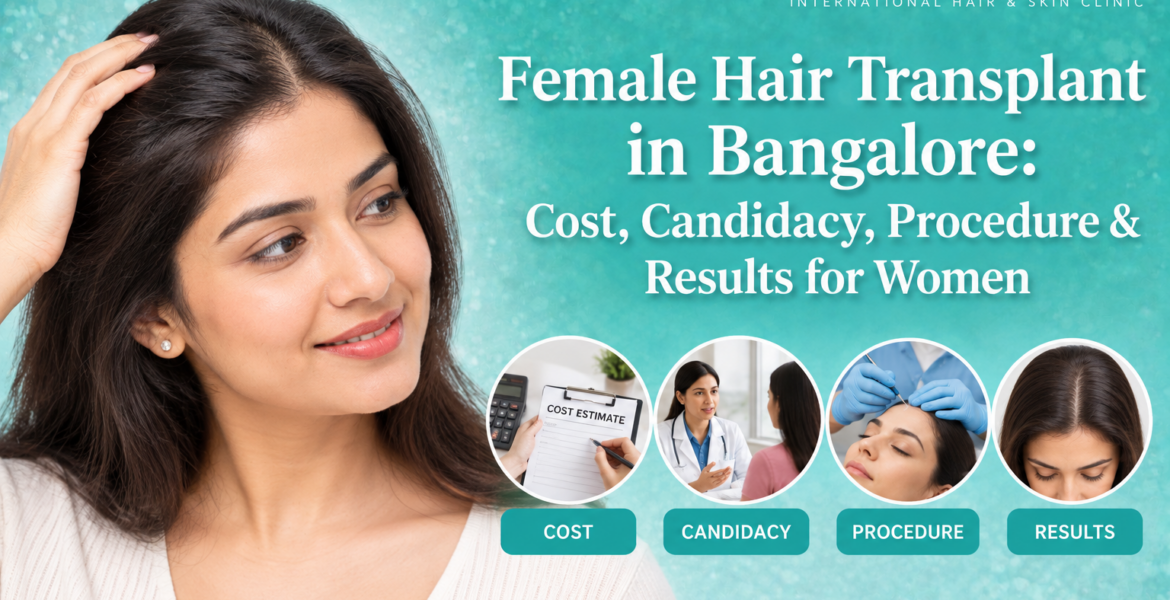
Hair thinning and hair loss can affect women at different stages of life. Hormonal changes, genetics, nutritional deficiencies, stress, medical conditions, and certain hairstyles can contribute to visible thinning or reduced hair density. When non-surgical treatments do not provide the desired improvement, a hair transplant may be considered.
A hair transplant for women Bangalore patients can consider is a procedure designed to redistribute healthy hair follicles from a suitable donor area to areas experiencing thinning or hair loss. At Haircosmos International, treatment planning is personalized according to the patient’s hair-loss pattern, donor hair availability, expectations, and overall scalp condition.
What Is a Female Hair Transplant?
A female hair transplant involves moving healthy hair follicles from a donor area, usually where hair growth is relatively stable, to areas with reduced density. The goal is to improve hair coverage while maintaining a natural-looking hairline and overall appearance.
Women often have different patterns of hair loss compared with men. Instead of extensive bald patches, many women experience diffuse thinning, a widening parting, reduced density around the hairline, or thinning in specific areas. This makes detailed assessment important before deciding whether transplantation is appropriate.
One important consideration for women is the visibility of the procedure. Complete scalp shaving is not always required for a female hair transplant. In selected cases, a no-shave or partial-shave approach may be considered depending on hair length, donor density, the number of grafts required, and the technique being used.
Who Is a Good Candidate for a Female Hair Transplant?
Not every woman with hair loss needs a transplant. A consultation helps determine the underlying cause and whether sufficient healthy donor hair is available.
A woman may be considered for transplantation when she has:
- Localized or pattern-related hair thinning
- A widening hair part or reduced density
- Hairline thinning or recession
- Stable areas of hair loss
- Adequate donor hair for transplantation
- Realistic expectations about the outcome
Some women may benefit from medical or non-surgical hair restoration treatments instead of, or before, a transplant. A detailed evaluation can help identify the most suitable approach.
Female Hair Transplant Procedure: What to Expect
The procedure generally involves several stages, but the exact approach varies between patients.
1. Consultation and Hair Assessment
The process begins with an assessment of the scalp, hair density, hair-loss pattern, donor area, and overall hair condition. The treatment plan is then designed around the patient’s individual requirements.
2. Donor Hair Preparation
Healthy follicles are selected from the donor area. For women, complete scalp shaving may not be necessary. Depending on the patient’s hair length and treatment requirements, the donor area may be left unshaved or only a small area may be trimmed.
A no-shave or partial-shave approach can help maintain the appearance of existing hair around the treatment area. However, its suitability depends on factors such as the number of grafts required, donor density, hair characteristics, and the chosen technique.
3. Follicular Extraction
Individual follicles are carefully extracted from the selected donor area using an appropriate hair-transplant technique. The aim is to preserve the follicles while maintaining the appearance of the donor region.
4. Graft Preparation and Implantation
The extracted grafts are prepared and placed into the areas where additional density is needed. Their placement is carefully planned to complement the patient’s existing hair direction and natural pattern.
Can Women Get a Hair Transplant Without Shaving the Entire Scalp?
Yes, some women may be suitable for a hair transplant without shaving the entire scalp. This can be particularly useful for women who want to maintain the appearance of their existing hairstyle during the treatment process.
A no-shave or partial-shave approach may allow the surrounding hair to cover the treated area. However, it is not appropriate for every patient. Hair length, donor density, the number of grafts needed, hair-loss pattern, and the transplant technique can all influence whether this approach is practical.
At Haircosmos International, the treatment plan can be discussed according to the patient’s individual hair characteristics and aesthetic goals.
Is a Female Hair Transplant Painful?
Hair transplantation is generally performed using local anesthesia to keep the treatment area comfortable during the procedure. Some patients may experience mild sensations during preparation or extraction, while temporary tenderness, swelling, or sensitivity can occur afterward.
The experience can vary from person to person, so patients should discuss any concerns about discomfort during their consultation.
What Results Can Women Expect?
Hair transplant results develop gradually. Newly transplanted follicles require time to settle and enter their normal growth cycle. Some transplanted hair may initially shed before new growth becomes visible.
Over the following months, hair growth and density can gradually improve. The final appearance depends on factors such as follicle survival, donor hair quality, the extent of hair loss, treatment technique, and individual healing.
Because every patient is different, results cannot be guaranteed or predicted solely from another person’s outcome.
Recovery After a Female Hair Transplant
Recovery varies depending on the procedure and individual healing response. Patients may experience temporary redness, sensitivity, mild swelling, or small crusts around the treated areas.
For women undergoing a no-shave or partial-shave procedure, existing hair can help conceal the treated area, which may make the immediate post-treatment appearance less noticeable. However, the exact appearance after treatment depends on the technique and the extent of transplantation.
Patients should follow the aftercare instructions provided by their hair-transplant team to support proper healing.
Women’s Hair Transplant Cost in Bangalore
The women’s hair transplant cost can vary significantly between patients. There is no single price that applies to every female hair transplant because treatment requirements differ.
Factors that may influence the cost include:
- Number of grafts required
- Extent and pattern of hair loss
- Donor hair availability
- Transplant technique
- Complexity of the procedure
- Individual treatment requirements
A consultation is the best way to understand the expected number of grafts and the treatment plan before discussing the overall cost.
Why Individual Planning Matters for Women
Female hair loss can have several possible causes, so identifying the reason for thinning is an important part of treatment planning. A transplant may not be the first choice if an underlying condition is causing ongoing hair loss.
Women also have specific aesthetic considerations, including preserving existing hair, maintaining a natural-looking hairline, and minimizing visible changes to the donor area. For suitable patients, discussing no-shave or partial-shave options can be an important part of the consultation.
Haircosmos International team focuses on individualized treatment planning based on the patient’s hair condition, donor area, goals, and suitability for transplantation.
Final Thoughts
A female hair transplant can be an option for women experiencing suitable patterns of hair loss and looking for a long-term improvement in hair density. Importantly, complete scalp shaving is not necessarily required for women. Depending on individual circumstances, a no-shave or partial-shave approach may be considered.
If you are exploring a female hair transplant in Bangalore, a professional assessment can help determine whether transplantation is suitable for you, how many grafts may be required, and whether a no-shave approach could be considered based on your hair characteristics.