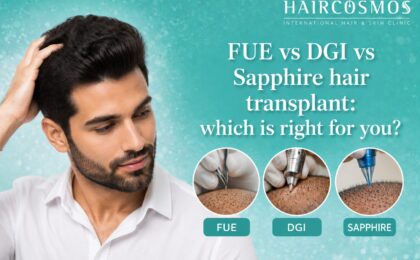
Selecting the most effective hair transplantation method that meets your hair goals is a crucial consideration. But now that you have started your journey to recovering your full head of hair, it’s time to understand the right treatment. So, which hair therapy is better: DGI vs FUE?
Direct Hair Implantation and Follicular Unit Extraction are the most important hair restoration methods. So, you may experience difficulties understanding the right process. While you can take advice from the surgeon, how about conducting your own survey? On that note, here’s presenting the ins and outs of DGI and FUE treatment.
DGI and FUE Treatments, In a Nutshell
DGI, or Direct Hair Implantation, is the modern FUE, which is performed similarly to the FUE. Here, the surgeon removes hair follicles from the donor area on your scalp and implants them in the desired area.
The only difference is that the surgeon does not implant every individual hair follicle manually. DGI uses a pen-shaped tool for cutting and implanting hair follicles simultaneously. As a result, it offers a speedier result. Most importantly, there’s no requirement for skin grafts or implantation separately.
On the other hand, FUE hair transplant involves individual hair grafts taken from the head’s back to avoid scars. This type of hair transplant reaps better results and offers higher growth of the new hair. As of now, the success rate for this treatment is more than 90%.
Differences between DGI and FUE: Comparing Both in the Table
The following is the difference between DGI and FUE in a table:
| Differences | FUE | DGI |
|---|---|---|
| Candidates | Patients having larger areas of baldness and hair loss | Patients with low to medium loss of hair |
| Tools | Needle-nose pliers/forceps | DGI Implanter |
| Small incision size | 0.7-1 mm | 0.5-0.9 mm |
| Disadvantages | Trauma to the root cells and hair follicle
Shaving (based on the patient) Scarring |
More than one session is required |
Both these treatments need at least 1 to 2 years of time to achieve 100% hair growth.
Graft Handling in FUE and DGI
DGI uses an innovative device called the Choi Implanter Pen to handle grafts to deliver more accurate results. The angle, direction, and depth of each hair follicle may be controlled using this pen. The outcome is the hairline that looks more natural.
On the other hand, in FUE, individual follicles are achieved manually by technicians or surgeons. Then these are implanted in the recipient area. Precision-wise, this method lacks the level of efficiency that DGI offers with the Choi Implanter Pen.
Downtime and Recovery of DGI and FUE
Unlike other hair restoration procedures, DGI doesn’t require waiting for seven days. Patients can wash their hair 24 hours after the treatment. So, here, the recovery time is greatly decreased as the implantation tool makes smaller incisions ranging from 0.5 to 0.9 millimetres. In the end, it offers a natural outcome. The surgeon controls the depth, angle, and direction of the hair based on the patient’s preference.
Contrarily, FUE offers a 90% success rate. In addition, the incisions range only between 0.7 and 1 millimetres, which improves healing. This hair restoration method is speedy, where patients don’t have to wait for seven days. They can wash their hair after 24 hours of the treatment.
Scarring Concerns Associated with DGI and FUE
In FUE, patients may see visible scarring. It leaves small white marks on the donor site where the hair follicles are removed. The best part of undergoing FUE, however, is that it uses a larger area when compared to DGI. The minimum scarring caused in the process aids in a faster healing period.
Although DGI is limited to 4000 grafts, it has no visible scarring. During the hair transplant, the doctor uses a pen that cuts the graphs and reimplants follicles. This process resembles the FUE hair transplant method. But here, patients enjoy minimal scarring and faster recovery.
Benefits of DGI or FUE: Which One is Right for Your Hair Goals?
DGI is suitable for people with moderate or mild baldness. Patients with advanced hair loss cannot achieve the maximum results from this treatment. In severe hair loss cases, the surgeon recommends other methods.
Compared to this treatment, FUE implants hair follicles in other areas in addition to the scalp, where there is visible hair loss. FUE can be used for achieving perfect eyebrows, moustaches, sideburns, and even beards.
It offers a quick recovery, given that FUE’s incisions range between 0.7 millimetre and 1 millimetre. Patients can wash their hair within 24 hours. Since the process involves needle-nose pliers, forceps, and other tools, the surgeon must possess meticulous skills. FUE (unlike DGI, which is limited to 4000 grafts) can be used for treating larger areas of baldness and hair loss.
Choosing DGI vs FUE: How to Select a Hair Transplant Expert?
The following are the top parameters to evaluate when choosing a hair transplant expert or clinic.
Experience
The professional should have years of experience and proficiencies in offering successful results. The surgeon should have the professional acumen to deliver a customized result based on your requirements.
Aftercare Solutions
If you are planning to choose a clinic, look for one that ensures customer satisfaction. It should offer comprehensive support and post-operative care for seamless healing.
Other criteria you must not refrain from assessing are the surgeon’s credentials, the clinic’s reputation, advanced technologies used, and cost.
DGI vs FUE At Haircosmos International
Haircosmos International is the one-stop hair care clinic committed to providing patients with the highest standards of expertise and care. The surgeons can offer the best FUE hair transplant in Bengaluru.